Monday, February 05, 2007

"Pan's Labyrinth": Bad? Really? But First, Andy Dick Self-Destructs

Okay. Got some video goodness for you. (The picture link doesn't actually work, by the way -- just click on this here hotlink coming up). It's a video of Andy Dick getting kicked off the Jimmy Kimmel Show. Wow. As you'll see, he's sitting on the couch with second guest Ivanka Trump. Kimmel asks her if she has a boyfriend. Dick, sauced, says, "You're looking at him." Then he says, his voice slurred, "I need a fucking sugarmama." Then a bit of glitter catches his eye and he starts to rub her leg. Kimmel reaches over Ivanka to take Andy's hand off. Everyone gets over that, but when he does it again, Kimmel and an old security dude come in and take Andy away. Andy looks up at them and says, laughingly, "Am I out?" He doesn't look altogether sure if he's really going out or not. He is. I saw Andy Dick on Letterman a while back and his theme of the night was "getting back to sobriety". Letterman, I thought, was very condescending in that dickish way of his that he doesn't indulge as often as he used to, but Andy was a sport and it looked like he was serious about cleaning up. As his Kimmel appearance makes clear, sobriety didn't work out. Anyway, fun video.

Well, I've been seeing a few movies during this mini-book-finishing hiatus. I am very nearly done with the revisions on el novelo and will very soon be entering the changes into the Word file. Done by Sunday. Done by Sunday. Done by Sunday. It will happen.

Anyway. I saw Guillermo Del Toro's "Pan's Labyrinth" over the weekend and, surprisingly, I was underwhelmed. Really disappointed actually. A whole cadre of respected genre artists like Stephen King, Frank Darabont, Clive Barker and Neil Gaiman all saw "Pan's" together sometime last year and heralded the movie as a masterwork and a film of genius and all of that. One of those guys saying that stuff, sure, a grain of salt, but all of them? So when I ambled into the theater Friday night, I was not expecting anything but filmic goodness. There was not a whole lot of that.

"Pan's Labyrinth" is set in Spain during the Spanish Civil War. A little girl named Ofelia (Ivana Baquero) and her mother settle into a garrison in the countryside run by Ofelia's new stepfather, Captain Vidal (played with gusto by Sergi Lopez). Vidal's hunting the Communist rebels who are hiding out in the hills near the garrison. Vidal's a mean vicious guy with no redeeming qualities. No human traits. He'd kick a puppy with as much fervor as he'd kick an elderly woman in a wheelchair. We get hints that it has to do with his dad. Whatever. We first get a taste of his sadism when he kills a guy by slamming the bottom edge of a whiskey bottle into his face over and over. Guillermo, who seems to love that stuff, shows it in loving detail. Oh, Guillermo. If it seems like I'm talking a lot about Capitan Vidal, it's because Guillermo does, too. Vidal's gruesome, Mengele-style hijinx occupy most of the film's attention, which kind of sucks all the air out of the rest of the movie, the rest of the movie concerning Ofelia's being visited by fairies who say she's the long lost princess of the Underworld, reincarted in another body. One night she descends a spiral staircase at the end of an old labyrinth near the garrison. Pan comes to her (or, just a faun as it's called in the original Spanish title, "The Labyrinth of the Faun") and tells her that if she completes three tasks then she may reclaim her rightful place on her Princess throne in the Underworld. This sort of thing is the meat and potatoes of children's stories. Harry Potter's not just an unloved adoptee, for example, but the greatest wizard of all time. Eragon's not just a peasant -- whatever. He rides dragons or something. Anyway, the point is that this movie looks like it's suitable for kids, but it is not for kids, which is part of the reason why the movie's frustrating for me.

The movie's built like a fable -- simple. A child could watch it and not miss much. That's not to say an adult can't enjoy a movie structured as a fable, but it's not the preferred storytelling mode for those in the 12 and up demographic. But when a guy who gets way off on gory horror gets a hold of a children's fable, and doesn't think to hold back on the gratuitous gore effects for this new audience, the question comes up pretty fast: who the hell is this movie for? As an adult, stories of children completing three tasks (one of which is to feed a big toad under a tree magic stones) is kind of boring for me. I'm starting to think, "Oh, that's why I'm nodding off. This really is for kids." Then comes the face smashing via the whiskey bottle. I'm not nodding off anymore. I'm looking for my cell phone so I can call my mommy. Fricking gross. Now I'm thinking, "Not only is this not for kids, I don't think it's for me either." It only gets worse from there. But strong storytelling can often overpower objections to artless tone shifts. If only we had any here.

"Pan's Labyrinth" is not a weak story exactly -- perhaps told a different way it'd make a fine film or young adult novel. But Guillermo (who also wrote it) gets lazy a few times, and the characters do stupid shit that make you throw your hands up and quit rooting for them. [SPOILER AHEAD.] For example, before Ofelia begins her second task, Pan tells her explicitly not to eat anything off of a big banquet table she'll encounter while doing the second task. Pan tells her doing so could kill her. Ofelia finds the table, sees the creepy eyeless monster at the head of the table who sits motionless, not seeing her. She does the task and then, you guessed it, eats something off the table. A grape, no less. No reason other than she was hungry. Lazy, Guillermo. Lazy. Again, if this is a kid's movie, you can get away with this kind of unjustified BS, but Guillermo's aiming for an arty prestige movie so this unmotivated character action doesn't cut the mustard. Maybe the cheese. [SPOILER DONE.]

At that point I essentially gave up on the movie. The ending did what good stories are supposed to do, namely tie up loose ends, and it does that, but -- well, I don't want to give that away at least. So, in the end, I don't know what all those writers and filmmakers were thinking. When "Pan's Labyrinth" comes out on DVD, check it out, see what you think. Maybe I'm way off.

Wednesday, January 24, 2007

A Lamentable Oscar Oversight, Political Vids Designed to Amuse and Enlighten, and a Urine-Gargling Deer Video

Oscar nominations are in as of yesterday morning. Overall, the choices were predictable and honored those studios who no doubt mounted rigorous campaigns for their favored films. "Departed", probably the best film of 2006, was appropriately honored, I thought. Picture, Director, Screenplay. I really liked seeing Wahlberg get a Supporting Actor nomination. The lines written for him were genius, and he delivered them perfectly. (Isn't it weird that Marky Mark and the lead in "Fear" is now an Oscar nominee?) My one major problem with the nominations this year was this: "Borat" got a nomination for Best Adapted Screenplay while "Prestige" (and countless other deserving scripts, I'm sure) was ignored in that category. If the Academy doesn't think Christopher Nolan and his brother wrote one of the best adapted scripts of the year, fine -- no one would ever accuse them of having exceptional taste -- but to honor "Borat" with a nomination? A movie that was a collection of clever bits Cohen improved his way through, all of which is hung on a weak Borat-Has-To-Marry-Pam-Anderson plotline? Not to defame a movie I thought was pretty funny, but Best Adapted Screenplay? I'm guessing Academy members (or is it just Writers' Guild members who do the screenplay noms? Shawn?) just wanted to see what funny things Cohen will say if he goes up and gets the award. And for that reason, I bet there's a good chance he'll get it.

Also, some fantastic political video clips this week. Here's one of Wolf Blitzer interviewing Darth Cheney. This thing is guaranteed to make you squirm. Okay, maybe not Heath. What's especially good about the clip comes at the end when Wolf starts asking Darth about the fact his lesbian daughter's having a child with another woman. in response, Cheney levels Wolf with his Lidless Eye of Sauron and Wolf withers beneath its unclean glare. He stammers and stutters and retreats. If I didn't hate Cheney with a purple passion, I'd almost have to hand it to him for so completely discombobulating a member of the press, especially the usually unflappable Blitzer. I think Wolf's problem was trying to join two completely different sentiments, one being a phony journo congratulations on Cheney's new granddaughter, and the other being a tough (and legitimate) question regarding the Vice President's hypocrisy on the subject of gay rights. It was too difficult a transition to make for ole Wolf, though I commend him for making the attempt. It must have something to do with the Cheneys. Uberbitch Lynne Cheney also gave Wolf hell, though she had even less reason to be so than her husband. Anyway, this is what happens when you deal with a politician who's cranky by nature and is entirely unconcerned with their political future. Disdain for the press times a hundred.

And here's Chuck Hagel making an impassioned speech about the war. Nary a thing he says in this clip is untrue, and he says it well. You should check it out -- it's just good.

Also, Obama calls out FoxNews for its completely lame-ass smear job it did on him last week. Some right-wing website publishes a completely uncorroborated report that Obama had attended a madrassah when he was a small child. FoxNews, because they are in no way a legitimate news organization, aired the story on the air without any independent sourcing of their own, and now a lot of regular folks believe that at some point in Obama's life, he was Muslim. Truth is neither his white Kansan mother or his secular Kenyan father (who he saw once his whole life) was a Muslim and he is and has been for some time, a Christian. Also, a madrassah is essentially Muslim grad school, so Obama being in one at the age of 8 or so, is ludicrous on its face, But the damage is done and Obama called them out in this letter, by name. And the thing is FoxNews's position is indefensible, so if they're smart they'll just take it. Which means they probably won't.

And just to round off all this political stuff with some uplifting news, here's a link to a Rolling Stone article that talks about the still-possible Gore run. James Carville thinks he'd be damn formidable and would be absolutely shocked if he didn't run. I hope I hope I hope. The wife hopes, too. Even more than me, if that's possible.

Well, the wife's back from India and she saw a whole lot of it. I don't want to attempt a rough transcript of what she told me, but I'll say that based on her first-person account, my opinion of India, already low, has hit absolute bottom-of-the-Marianas-Trench levels. Talk about a country fatally hamstrung by a religion-inspired c'est la vie outlook on its dire national problems. 60% of Indians live in filthy slums. 20% are homeless. When asked about the trenchant poverty, the other 20% of middle-class and outright rich Indians tell you the desperately poor are "content" in their slums or begging on the streets. No problems here! What's to fix? Anyway, I'm going on and on and I didn't even go. She took lots of excellent and well-framed digital photographs during her travels, and also, incidentally, a video clip. I'll just put the link here. Who knew Indian stags were such horny freaks? Anyway, good times -- take a look.

And finally, one space or two? Up until this past week I didn't know ANYONE was using a single space between sentences, but I now realize I, in fact, am the only one still using two spaces. Is it really just me? How widespread is this one-space epidemic?

Aaaaand I'm out.

Sunday, January 21, 2007

"Godfather" Makes Demands on My Time, "Rome", and Some Deeply Inane Ramblings on the Field of Democratic Contenders

Hey dudes and dudettes. I know -- I've been sucking it as a blogger lately what with my rambling and infrequent postings. Here's what I've got working against me. I'm going to be 30 in less than a month, and my current plan to stave off the crushing depression that may or may not accompany that landmark birthday is to have my goddamn novel done and done. I'm on page 293 of a polishing line-edit on my 497-page tome you're all no doubt tired of hearing about, and I want to get that done before the 11th. Now here's the other thing I've had working both against this admirable goal and bloggin' this week. I've been sick.

The illness goes by the name of "The Godfather" for the XBox 360, and man have I been suffering. Stumble out of bed at noon because I stayed up till 3 the night before playing "Godfather", fix a shitty lunch of a turkey and cheese sandwich with a tasteless stack of pretzels to go with it, all washed down with some DC (Diet Coke for the uninitiated), and I set all that bizness on the coffee table and pick up the beautiful white 360 controller and get things rolling. "The Godfather" game, which is not a new title and was just modded out for the 360, is damn playable. Addictive even. When I was playing it, I didn't even want to be playing it, but I felt compelled. If I extort just one more business, I thought, the whole game will be different. One more hit for Don Corleone and I'll get a promotion to Underboss. I played it a lot. There's a helpful/depressing play-counter that comes up each time you save the game that lets you know EXACTLY how long you've been playing. I think by the time I beat the game by becoming Don of New York, I'd put in a full day's worth. The big 24. One of the fun things (more fun when you first start playing) is that you can design a character that looks like you. Well, pretty close. My guy looked more like Ben Affleck than me, (they didn't have a setting for my particular hairline, which would have really sold it), but it was close enough to be funny. When my brother came by to play (he bought the game for the PS2 a few days later such is its addictive quality), we designed a character that looked like him, down to what he was wearing, which was a total white guy-looking yellow button-up shirt. Watching a bearded, yellow shirt-wearing Patrick run around Little Italy extorting small business owners was hilarious. Anyway, I packed it back up in its GameFly mailing sleeve and mailed that mutha off. My fever has broken. I am free.

In other news, the wife gets back tomorrow from India. She's on her way to France right now if she's not already there. From gay Paree straight to the equally sophisticated environs of Hotlanta. It'll be good to have her back.

I've been watching the first season of "Rome" on DVD. I forgot how many of those first epsiodes I'd already seen. As a result, the first disk was just a rehash so I was kinda sorta looking forward to the second disk but, wouldn't you know it, the disk is scratched and wouldn't play any of the three episodes in their entirety. I think I'm done with "Rome" now. Not just because I can't actually watch the 3rd 4th and 5th episodes, but also because I don't really care what happens to these characters. When wifey first told me they were doing the show a bunch of years ago (I think at the time Warner Bros. had something to do with it), I was excited about it. It sounded like an exploration of the politics of ancient Rome, which sounded to me like a great idea. In actuality, however, the show they finally came up with feels like a fairly disinterested summarizing of great swaths of Roman history populated with generally unlikable characters. What fun. Also, the show depicts Rome at its height to be not as grandiose as it seemed in movies like "Gladiator", but more rundown and sparsely populated. Weeds spring up from the cobblestones, and the like. It's an expensive show from all accounts, but the sets look like sets and the extras look and act like extras. It isn't a convincing or terribly compelling portrait of that time. So I wash my hands of it. Thought you'd all like to know about that.

Mmm, politics. Both Hillary and Obama jumped into the presidential race this week. I feel like we just finished with the Bush/Kerry election, now we're doing it again? Hillary's not a completely unappealing candidate, but she's positioning herself too strenuously for the general election. If she gets the nomination it will be with the same feeling of weary resignation with which the Dems nominated John Kerry for President. No one was terribly excited about Kerry (my un-excitement culminated with his speech at the Democratic National Convention when he saluted the audience and said, "I'm John Kerry and I'm reporting for duty", at which point he snapped off the salute. How could anyone not be unexcited after that?), and no one seems excited about Hillary. (Though the idea of getting Bill back in the White House has its charm). People are enthusiastic about Obama because he's an appealing candidate, nevermind what he thinks. Unlike Hillary he can speak well and doesn't always come off like he's making political calculations everytime he opens his mouth. His candor on "Meet the Press" last year when Russert pressed him on a possible run was refreshing, and immediately set him apart. But what does he think? Yes, he was against the war back when it counted, but he wasn't in the Senate then to actually cast a vote like all those other poor saps. So far as I know, that's the only positions he has. When asked about the other issues that generally divide the electorate, his stock answer is to speak extemporaneously about coming together and unity. I like unity as much as the next guy, but the fact is as an electorate we're divided right down the middle. Sooner or later, he's going to piss off somebody when he takes a position on an issue. Whether it's the liberals (whom Hillary's pissed off with her so-far unregretted vote for the war), or the conservatives remains to be seen, but right now all of this early excitement seems way premature. Besides, I'm still holding out for Gore. I know. Fat chance, and getting fatter all the time. Still I hope.

Anyway, if you got all the way through that congrats. Enjoy your Sunday.

Monday, January 15, 2007

A Rambling MLK Day Post

I'm watching the Golden Globes. Warren Beatty just got off the stage after a rambling, un-written speech for his Lifetime Achievement Award. Now Speilberg's up to give the best director award. Two noms for Clint. Yawn. C'mon, Marty. Marty... yeah. He got it. I hope this presages his getting it next month.

Anyway. So Matt Drudge. Son of a bitch. I don't know if any of you happened to catch the top headline on his page yesterday, but he gave away the end to tonight's ending of "24", which was, and I'm going to give it away here [SPOILER!]: the detonation of a nuclear weapon in Los Angeles. I don't know how surprised I would have been to have watched that ending because Drudge told me all about it last night. But I bet it might have been an effective and shocking TV moment. Anyway, like I said, what a son of a bitch. I even wrote him an email. I was completely polite within, no profanity or threats, but I'm sure it'll go right into the hate mail trash file. Bastard.

Also. My Crown Vic. The wheel the car thieves smashed has been acting up of late. Whenever I engage the brake actually. I took it to Brake-O and they wouldn't touch it because they didn't have the hubcap key. The tire guys who put new tires on my car last year didn't need it. The people who fixed my car after the theft asked for it, but then figured it out without my help. These guys: no dice. So now, before I can have my brakes fixed, I'll either have to order a hubcap key or take it to a Ford dealership where they'll happily charge me 200% over what anyone else would charge. Anyway, that's what I was dealing with today -- thought I'd whine in print.

Finally. I saw "Children of Men" on Friday night, but before I get to that, what is going on with admission prices? What is it in Los Angeles these days? $13? Is the ArcLight at $20 yet? My shitty AMC is charging $9.25 for an evening show. Matinees end at 4PM. It used to be 5. Anywho. "Children of Men". Frickin' great and damn harrowing. Cuaron did an amazing job and everyone should see this one, even if it is $9.25.

Wednesday, January 10, 2007

Brian Says "Read 'The Road'"

I finished Cormac McCarthy's "The Road" this afternoon. Nevermind the terrible cover, the book's amazing. There are no chapter breaks, only double spaces between sections. The prose is stark -- in most cases McCarthy's sentences make Hemingway's writing look wordy and overcooked. My intention was to pick up the book from time to time but it didn't work out like that. I got 70 pages in yesterday and then sped through the rest today. Yes, the story's setting is unceasingly bleak, but it feels important; elemental. McCarthy assigns no character names to his two main characters, referring to them only as "the man" and "the boy". This minimalism, combined with a litany of stripped down sentences appearing to give little more than the basic facts of the story, gives the impression that "The Road" isn't just a story, but one of The Stories.

The man and the boy, a father and son, walk down a road pushing a shopping cart filled with their belongings. A nuclear war years ago killed off most everyone else. Nuclear winter obscures the sun and food exists only as what the first wave of scroungers. Though they're mostly on their own, the biggest threat to their existence, aside from starvation, are other people, many of whom have been driven to cannibalism by the scarcity of food. Harrowing throughout, but damn riveting. Not a moment of this book seemed off-key to me, but many parts were illuminating and nightmarish at the same time. I thought at various times while reading the book, "Would people really do that to one another?, but then again, of course they would. When a Mahdi army soldier in Iraq boasts to a reporter a month ago about how he uses a drill on the skulls of his live victims, how can a sane person underestimate the depravity humans are capable of? This is how the end of the world could very well look and its sobering and moving. The ending of the book is brilliantly done and makes perfectly clear from a technical standpoint why the crushing despair that preceded it was necessary. Emotionally, the ending's a wrecking ball. Anyway, it's damn good stuff and I reccomend it.

In somewhat related news, tonight Bush gave his speech trying to justify sending an additional 20,000 troops to Iraq. Did anyone else watch this? Was it just me or did it seem like he was bringing his Texas ranch-hand accent down a few notches to make himself seem like less of an asshole? Anyone think it'll work?

Tuesday, January 09, 2007

Herein I Rehash Yet Another Lecter Movie. This Time It's "Red Dragon"

Watched "Red Dragon" tonight, just like I threatened I was going to do yesterday. I saw it in theaters years back and liked it, though with misgivings, mostly about Norton's age and Hopkin's spare tire that no amount of strenuous girdling can disguise. I don't feel much like writing coherently tonight, so I'll just write my thoughts up in list form.

What I Liked:
1) The conversation Anthony Hopkins and Edward Norton have right before Graham puts two and two together and realizes Lecter's the killer. It's fascinating to see in that brief conversation how Hopkins' Lecter would have acted in polite company. In "Silence" Hannibal can say whatever he pleases. He can be rude without fear of consequence. In this brief scene we see him in his human clothes and Hopkins makes some great choices, or so they say in actorly parlance. Sure, Hopkins is too portly and too old to be entirely believable this go-round, but he's damn good so he makes some good stuff from what he has to work with. (Did you know that it was Hopkins' performance in "Elephant Man" that inspired Demme to consider him for the role of Lecter? Pretty interesting.)

2.) Ralph Fiennes performance. I thought he was brilliant when I first saw the movie and I was struck once more by how effortlessly he shifts from terrifying to vulnerable, all without ever appearing to overact or ham it up. Is Fiennes like the new Jeff Bridges? In that he's the guy who's one of the best actors working but always manages to so lose himself in each role that you forget about the actor on-screen? I don't know. Fiennes is always good. From "The Constant Gardener" to "Harry Potter", dude does it all.

3.) Some of Ratner's choices are actually good. I like that he used the same style of titles as they did in "Silence" to signal a locale change. Also there a few scenes in flourescently-lit police-building milieus that look so much like scenes in "Silence" that you might be fooled into thinking Tak himself had shot them. I also like that the actor who played Dr. Chilton in "Silence" is back, though I wish Scott Glenn had reprised his role as Crawford. Harris's Jack Crawford character has been portrayed in three movies by three different guys but only once did they get the casting right. Harvey Keitel? Really?

4.) Philip Seymour Hoffman's performance. To me it's kind of lazy and you almost get the sense that Hoffman doesn't actually like the character he's playing (which is not to say he doesn't enjoy doing the role, only that he doesn't in any way sympathize with the character), but it works and it's funny. When Hoffman's leaving the office after conducting a fake interview with Edward Norton, he says, "Nice working with you," and then, softly, "...chumps." Hilarious. I'd forgotten that line.

5.) Ted Tally's script. Guy knows how to put a screenplay together. He handles the false ending beautifully.

Things I didn't Like:
1) The movie's set in the 80s, about the time that Harris's novel came out, but Ratner never really seems to go for it. Yeah you see the old 80s Crown Vics driving around, but what about the ridiculous 80s haircuts? Edward Norton's bleached-by-the-sun do looks pretty goofy, but not particularly 80s. Thinking back I am remembering certain aspects of it that were blatantly 80s (Frank Whaley's Member's Only jacket for instance), but no would ever mistake this movie for a period movie, which I think was a missed oppurtunity.

2.) Edward Norton's performance. He did an interview with The Onion's AV Club (which I think is still up -- here's a link), where he talked about giving restrained performances, probably speaking specifically about his work in "The Illusionist". I didn't have a problem with him hanging back in that film, but in "Red Dragon", I think he takes the restraint too far, particularly at the end. When he realizes that Dolarhyde has come to his Florida home and may or may not have his son, his eyes don't really change. They convey no emotion. He doesn't appear scared. I'm not sure I wanted to see wide, terrified eyes, but I would have liked some indication that he was really scared, or freaked out in some way. He's so emotionally withdrawn in that scene it's as if Ratner shot a run through of the sequence and just kept it in the movie. Part of what was so brilliant about Jodie Foster's performance in "Silence" was what she did in the green glow of Buffalo Bill's night-vision goggles. You could see how terrified she was in that scene, and, at least for me, her stark terror heightened my involvement in the film. By contrast, when Norton opens the door and finds Dollarhyde with a mirror shard to his son's throat, his choice is to look disappointed rather than panic-y or even hyper-intense. There was an air of unreality about it that I think was half Norton's fault and half Ratner's fault for not caring enough to get the best performance.

Overall, though, I have to say "Red Dragon"'s a pretty good movie. Still miles away from "Silence" and, to me, not quite as good as "Hannibal", but nothing to sneeze at. I can't reasonably say that Ratner had nothing to do with it being a good movie, but I do think having a good Harris novel and a good Tally adaptation of that novel helped steer Ratner away from his usual tendency which is to ... I don't know. Soldier through the boring directing part and look forward to the wrap party and skeezing on chicks or angling for his next gig?

Anyway. Also, Shawn asked if I was going to have any comment on the new Harris novel, "Hannibal Rising". Actually, I was avoiding this one because the reviews confirmed that it was exactly what it appeared to be: a cheap quickie book published to coincide with the quickie De Laurentiis film of the same name coming out in a month or so. The Times said he was obviously "bored" with Lecter and I didn't want to read a half-hearted Harris novel, much less a half-hearted Lecter novel. But then some horror writer/readers did some reviews, and though they didn't rave about the book, they said it was worthwhile for fans of his previous books. So, being one of those, I picked it up just a couple days ago. I'm planning to read it when I get through with McCarthy's "The Road", which I just started today.

Hey, you know what's a bad idea? Reading McCarthy and then reading one's own work. Whoo. That's a work stopper.

Anyway. I's is outs.

Monday, January 08, 2007

"Hannibal" and "M.A.S.H.": Dissected

While I'm printing my book out (which is taking forever -- who knew printing 497 pages could require such close supervision?), I thought I'd jump on here and offer some of my world-class opinions on some movies I saw recently on DVD.

1.) M.A.S.H. When my folks exclaimed in disbelief at dinner a couple weeks ago, "You haven't seen the original M.A.S.H.?", I decided to fill in that objectionable gap in my filmgoing career and put it in the queueueue on our Blockbuster NetFlix-ripoff. It came and, in the spirit of two dutiful film-studies freshman doing homework, my wife and I watched it. I give "M.A.S.H." props for realism and a feeling of showing how things were without trying to make the characters seem more likable or the tone-skewing gore less gory, and it has an episodic, I-Hate-Plot sort of feel which isn't always a bad thing. Overall, though, the film's wildly uneven and some of the comic set pieces have more in common with one of those straight-to-video National Lampoon movies than with movies currently recognized as comic masterpieces, like, say, "Dr. Strangelove". The football game that serves as the film's titular climax just seemed very weird to me. It was as though someone had cut and pasted an earlier draft of the big game from "The Longest Yard" (the remake, not the original) into the "M.A.S.H." script and everyone was too high to notice.

2.) "Hannibal". Of course I've seen this movie (3 times in theaters) but I had a hankering to watch it again because I'd been listening to Hans Zimmer's excellent and gloriously overblown score of late. I loved loved this movie when it first came out, and I really like Thomas Harris's novel of the same name (and I didn't even hate the book's end, the one that killed any chance Jodie Foster or Jonathan Demme might return to the franchise). Watching it again I found myself more unhappy this time than last that Anthony Hopkins couldn't be bothered to drop a few pounds before filming. Hannibal Lecter is the character he'll be remembered for; I find it a real letdown that Hopkins wasn't more committed to bringing Lecter back to life. It wasn't as if he'd have had to forego eclairs and barbecue chicken wings forever, just until "Hannibal" wrapped. I understand that in the 10 or more years that elapsed between Lecter's fedora-wearing island walk at the end of "Silence" and the moment when Pazzi shakes hands with Dr. Fell in "Hannibal", and people change in 10 years, even monsters. But still, it's hard to imagine the larger-than-life killing-and-eating-machine Lecter letting himself go to fat no matter how much he likes food. Might slow him down when he'd most need to be agile.

Aside from that though, some of the sequences that I thought worked like gangbusters back in '02 still work like gangbusters now. (Like every damn scene in Florence, particularly the hanging of Commendatore Pazzi). And the way Ridley Scott and the actors handled the Krendler brain-eating scene at the end perfectly captured how goddamn horrifying that scene was in the book. Seeing the film again made me want to not only reread the novel, but also to revisit the Ratner-directed "Red Dragon", which I thought was only so-so when I saw it in theaters, mostly on account of the miscasting of Edward Norton and the even more regrettable portliness of Anthony Hopkins in a film considering the fact it's set BEFORE "Silence of the Lambs". Maybe they can go back through "Red Dragon" and do to Hopkins's face (and gut) what Ratner did to Patrick Stewart and Ian McKellan's faces in "X-Men 3". That would be some Lucas-style meddling I'd be all for. Anyway I've got "Red Dragon" sitting here on my desk all ready to get its ass watched.

I feel like there were more movies I was going to talk about, but they've all gone out of my head. I sure haven't seen any in theaters lately. "For Your Consideration" was the last movie I saw, though I think "Children of Men" will be the next. Haven't read a non-rave for that movie.

Anyway, book's done printing. I'm out.

Friday, January 05, 2007

Frozen wastes. A spectral Lovecraftian sky. Bodies half-buried in the snow. All on the cover of a novel with the words "The Terror" written across its front. It was as if they'd designed this book with me in mind. With a Barnes & Noble's gift card in hand, I was helpless not to buy the damn thing. This is how you sell literary horror.

Anyway, just thought I'd share with you this melding of the perfect cover design with the perfect title. On to the enjoying of the weekend.

A Hook for a Book

On the 15th of last month, an anonymous literary agent by the name of Miss Snark began accepting 'hooks' from unpublished novels written by the readers of her blog. For the price of on the house, she would apply her agent-tastic market sensibilities to each and every hook (which could be no more than 250 words), and offer suggestions on how to punch it up and make it more hook-y. If she liked it, she'd ask for pages, which later on she'd also post up on her blog, and then critique those. Even if she loved the material, she wasn't offering representation -- the process was intended only as a service to her readers and to supply her book marketing seminars with teachable material. She's done this sort of thing before, previously with first pages and synopses, and she refers to the whole exercise as a "Crapometer", which kind of presupposes the entries will all be crap, though, as with most unpublished fiction, that's a pretty safe assumption.

After a bit of hemming and hawing (who me?), I decided to take part in Snark's Crapometer and, at about 3AM on the morning of the 16th, I submitted a hook for my novel, "Claudine". (The rules stated that she would only read entries submitted between 8PM on the 15th and 8AM on the 16th.) All in all she received 682 hooks, of which mine was #617. She got to mine on the 29th of last month. This is what I submitted and what she reviewed:
"Miller Sturtevant wants a new house. He’s a handsome and slightly geeky CEO on the verge of a record-breaking IPO and he wants to trade up. Problem is his wife’s fine where they are, and he’s developed an irrational fixation on a gated community called Canaan Cove that’s never once put a house on the market. When a pair of residents die in a suspicious explosion, the neighborhood quickly offers Miller the newly-vacant house.

The moving trucks aren’t gone a week before Miller realizes there’s something’s very strange about his new neighborhood. The weird guardhouse attendant who never takes a day (or night) off, the dog next door that hurls itself against its chain all night long without making a sound, and cryptic, half-whispered mentions of a “machine” all have Miller wondering what the hell his neighbors are really up to. When a violent encounter with Christopher Rounsaville, the crazed President of the Homeowner’s Association, ends in a broken nose and a not-so-veiled reference to Miller’s role in Rounsaville’s mysterious plan, Miller’s suddenly thinking of ways out of Canaan. He soon discovers, however, that his captors have thought of everything. They need him for something and they’re not taking their eyes off him for a second.

A handwritten note promising a chance for escape changes everything. Soon after, Miller is immersed into a world of cults, murderous zealots, ritualized violence, and alternate dimensions that will reveal the terrible path Miller must travel to finally escape from Canaan Cove."

That took a few hours and 6 or 7 drafts to get to and even now as I read it, I want to re-write it. Two-hundred and fifty words is plenty for a log-line, but to hook someone's interest, it doesn't feel like a lot to work with. You can click here to find out what Miss Snark had to say about my hook, and then, if you want, click the comments to see what some other Snark acolytes chimed in with. She wasn't too hooked as you can see, but I'd say her comment fell somewhere in the middle range out of the other 681 submissions. For some a simple "WTF!?" sufficed, while she told others to re-think their entire books. So I'm weirdly relieved not to have gotten that kind of reaction. Anyway, thought I'd post it up and give the uninitiated a taste of what I've been working on for way too long.

Have a good weekend, folks.

Thursday, January 04, 2007

Alone and Drawing Boards in the New Year. Also: Saddam's Execution

Happy New Year!

Oh-seven has begun, and with its arrival has come the gift of paid labor, and the sorrow of spousal abandonment. Two days ago my wife left for India on her annual trip to places located outside this country. It's part of her business school curriculum, and because she's traveling with a bunch of other b-school students and teachers, I'm not too worried. She called last night for a minute or so from the airport in Mumbai to let me know all was well and that she was alive. In any event, she's left me to my own devices for three weeks. I'm sure it'll be fine for a while, but I figure by the end of the 3 weeks I'll be pretty well tired of life in Decatur with just me and the cat.

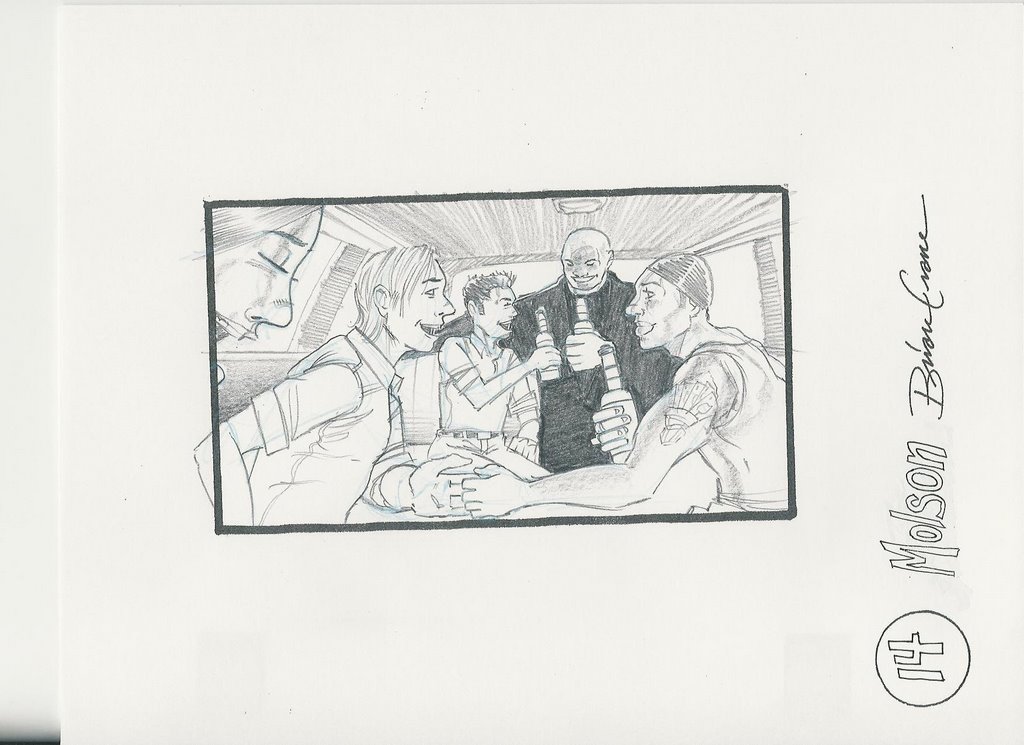
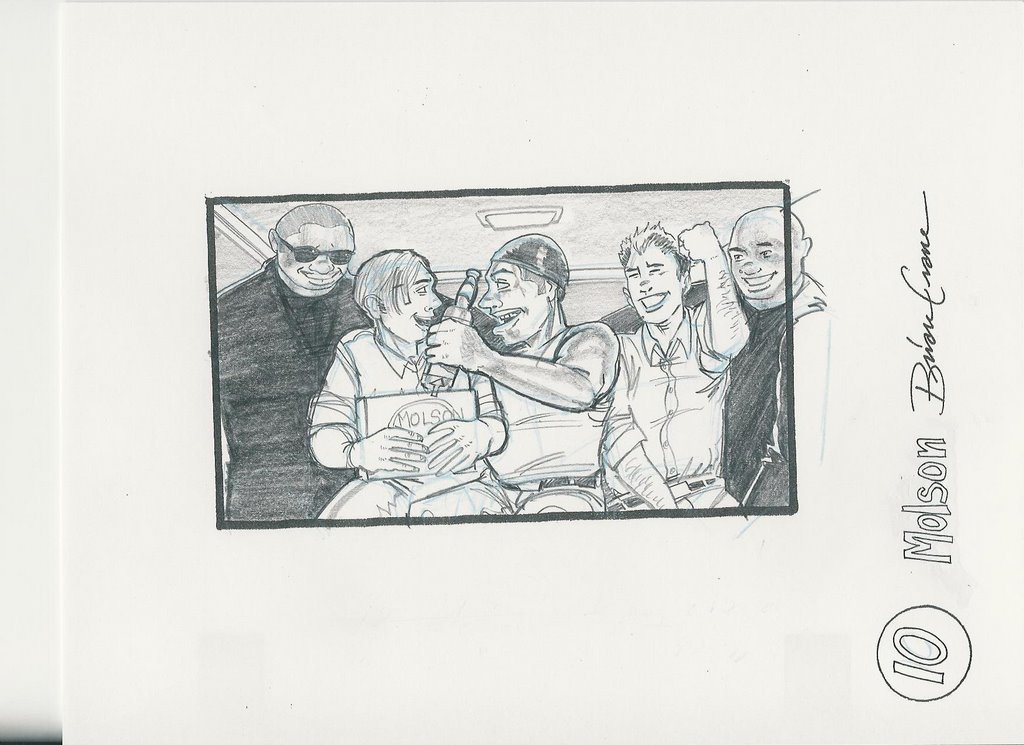
The paid labor I referred to is a new storyboard gig, this time for a commercial for a prescription canker sore medicine. The spot's pretty funny, or should be. If you see a burly guy in a pink body suit using a flamethrower on your TV screens some months from now, you'll know that's the spot I was talking about way back on January 4th. After it's aired, maybe I'll post up some of the boards.

In world news, the Iraqis -- or to be more specific the minions of Sunni cleric Moqtada al Sadr -- hanged Saddam Hussein just before the new year, and the cell phone-video taken of the scene has now been widely distributed on the internet. Yesterday Slate.com posted it up with a prominently featured link, complete with "Warning: Graphic" tag, seemingly daring users to click and watch the final seconds of Saddam. I already blabbed in this space about how I thought it was wrong to execute Saddam (or anyone actually), but I'd say the snippets I've seen from these ghastlty videos says much better than I can that no matter how you gussy it up, murder's still pretty much just murder. (For the record, I've seen the first video that was released which cuts off as the noose is being fitted around Hussein's neck; of the full snuff-film version, I've seen just the first few seconds). Most of the people complaining about the execution don't seem to be put-off he was executed, only put-off in regards to HOW he was executed. It was less a hanging and more a lynching, they say. For instance, Saddam was taunted by the Shiites who were killing him. They told him to "go to hell" among other things. They wore masks and shouted "Moqtada", referring to the powerful and thuggish Shia cleric who's often described as the real power in Iraq these days. Conspicuously, the Saddam death videos bear a close resemblance to the other snuff movies that have come out of the Arab world since 9/11. The beheading of Daniel Pearl, the beheading of Nick Berg, and other videos featuring masked men murduring helpless Westerners are all done in badly-lit rooms, and feature armed masked thugs and the defenseless victim awaiting their fate. All of them stomach-turning.

I suppose if everyone in the room with Saddam had been solemn and quiet throughout the execution, if someone had hoisted a few 10Ks into the corners to push back some of the dinginess, maybe there wouldn't be this outcry over the execution from the paid chatterers. But I doubt it. I don't think it's the insults or the dinginess or the haste with which the execution was carried out that's got people curiously upset. I think it's the video. For the first time that I can remember, the American people are seeing what an official execution of one of the bad guys looks like, and the fact that it's not all that different from the disgusting Nick Berg video is what's got people feeling bad and then feeling bad about feeling bad because of who's getting killed in an quasi-official way.


So I ask this: if capital punishment looks basically the same no matter what milieu it's placed in, might that suggest that the death we deal in this country -- brightly-lit, solemn and unmasked as it is -- has the same stink of murder to it as what was done to Saddam? Maybe I'm being optimistic, or maybe I'm overstating the level of outcry, but perhaps the nausea some folks feel over what was done to a mass-murderer like Saddam doesn't bode too well for capital punishment in the U.S. Then again, maybe I am being overly optimistic.

Anyway, enough of the high horse.

Sunday, December 31, 2006

The Inanities' Year in Review: 2006

One hour and fifty-two minutes 'till 2007.

I've had my ass handed to me a few dozen times playing "Gears of War" with adolescents of varying vocal pitch on my XBox 360, and I figured instead of having my tiny head blown off with a Grub-wielded shotgun one more time, I'd write a lil' somethin' somethin' on the ole Inanities. (Not that this is interesting, but I did write about 3/4 of a blog post night before last, but Firefox died on me and it went away. Yes, a true loss for American letters.)

2006, huh? What a year. I had my car stolen, recovered, and finally repaired, I received an unhappy phone call from a certain actor featured in a certain 10-minute video project, an unhappy email from a certain production design teacher, an unhappy comment from a certain "power lit blogger" (all as a result of keeping this blog which I didn't know would be so exciting) ,hung out with Shawn and Gretch (and her friend Melissa) up in Asheville where I saw the Biltmore Estate (AKA the Mason Verger Estate), and late in the year, got back into storyboarding. My wife did her summer internship, finished the first year of business school and started the second, my in-laws got two Schnauzer puppies named Sam and Frodo, which they love, and my folks moved out of L'Ville and into their country house, which they love. My sister started her education as a hair stylist, and my brother got the big promotion he wanted. It's been an eventful year, and a pretty good one, all considered.

My favorite movie of 2006 was Scorsese's "The Departed". My inclination is to say that 2006 was a bad year for movies, but out of the 50 or so movies I saw in the theater this year, I did see three absolutely fantastic movies, "The Departed", "The Prestige", and "V for Vendetta". I don't think many years pass that see three movies released in theaters I'd term instant classics, but 2006 was one of them. Ninety-five, the year of "Pulp Fiction" and "Shawshank Redemption", seems to come closest in my mind to producing a comparable raft of great films. But maybe my disappointment this year stems from the stuff I saw that was bad -- there wasn't a lot of middle ground this year. It seems like the movies of 2006 were either brilliant or mediocre or all-out god awful, soulless trash. Not a lot in the way of just "good" movies. I think this may have to do with the decreased output of the major studios and the added pressure on these films to succeed which pushes studio execs to make them as appealing as possible to the lowest common denominator. Movie-wise, I've got my fingers crossed for a better 2007, but I've got no good reason to be optimistic.

The book I enjoyed most that I read this year was Christopher Priest's "The Prestige" (incidentally, the filmed adaptation was my second favorite movie of the year). The best book I read last year (and this is different from 'enjoyed most'), was Nabokov's "Lolita". A Russian by birth, English was his second language and he still wrote it better than almost anyone else before or since. Also, I read aloud the Humbert Humbert parts in the voice of James Mason, thus tripling my enjoyment of the book.

Best TV Show of 2006: "The Wire". Favorite news event of 2006: Democratic takeover of Congress. Saddest Departure from TV Job Due to Illness: Roger Ebert. I hope he comes back soon. Well, there's 63 minutes until the new year and I don't want to spend them learning how to write a coherent sentence, so I'll leave it at that.

Happy new year, everyone. See you in 2007.

Thursday, December 28, 2006

Christmas Loot, "Gears of War", and The Execution of Saddam Hussein

Hello, all. Hope everyone had some good holidays.

As for me, Christmas was great this year. In the days before Christmas, my wife had Best Buy install a CD player into my Crown Vic without my knowing (my being generally oblivious helps), my in-laws gave me an XBox360 among other things (like a pocketknife, a bag of peanut M&Ms, and a little book called "365 Thing Every Man Should Know", which I can't help but think was intended as a comment of some sort), and my folks, privy to the impending gifting of the XBox360, bought me a game, "Superman Returns", an additional wireless controller, and a wireless internet thingie so I can do the XBox Live thing. A nice haul for my 30th Christmas.

Peggy also started a free trial membership to a video-game rental service called Gamefly.com. So on Christmas morn I had not only the so-far disappointing "Superman Returns" to play, but also "Gears of War", "Call of Duty 3", and a swat/X-Files hybrid game called "F.E.A.R.". The clear winner out of this grouping is, hands down, "Gears of War".

My brother came over last night and we played a campaign of "Gears" in cooperative mode till the wee hours and I'd have to say that "Gears" is the most-clever, most intelligently-designed video game I've played since "Halo". There isn't anything lazy about this game. A lot of games, of which "F.E.A.R." is an excellent example, are content to set up an overarching storyline and then lead the player through level after level which all look numbingly alike, killing gun-wielding baddies who all wear the same uniform. In "Gears", the designers designed the game as though terrified of ever letting the player get bored. Each level is thoroughly unique, ranging from shelled cities to decaying mansions to a vast complex of mines. Even within each level, each section is wholly its own bit of geography; every inch of the landscape looks as though it was designed and built by a studio art department, and with the same attention to detail. Storywise, there's very little in the way of exposition, which gives the game a you-are-there feel. Though there is a lot of grabbing cover and popping up to exchange fire with enemies, the designers break it up by introducing new weapons (like the Hammer of Dawn, which directs a satellite-originating laser onto your unsuspecting foes), and punctuating the action with exciting side missions. Anyway, it's a great game, and I'm about ready to play me some in the next little while.

It's been a newsy last week of 2006. James Brown and Gerald Ford passed over the past few days. If famous deaths comes in threes, as they say, then Saddam Hussein may well be the third. NBC is reporting today that Saddam Hussein may well be remanded over to Iraqi authorities in the very near term, and he will be hanged shortly thereafter, perhaps as early as tomorrow, but definitely before Sunday. I'm anti-death penalty, even in cases like this where we know the bastard's guilty, and I think it's wrong to kill Hussein. I think banning state-sanctioned murder, as most of the first-world industrialized nations have done, is a hallmark of a civilized society. Iraq is anything but, but in a place like Iraq where so many have died, and often senselessly and at random, I think commuting Hussein's death sentence would make an important and persuasive statement that the Iraqi leaders were substantially different from the insurgents who are currently fomenting chaos in that country by killing those in opposition to them. Commuting Hussein's death sentence would send a message to the non-violent Iraqis who are either fleeing the country or cowering in their homes, that killing is not the answer to any problem, especially not to those entrusted with helping Iraq back to its feet. I'm not naive enough to think that any statement the so-weak-as-to-be-useless Iraqi government might make would have much of an impact on what's happening there (which seems intractable and unfixable), but hanging Hussein seems to be the least thoughtful option.

Anyway. It's time to administer the death penalty to swirling masses of pixels on my TV screen.

Tuesday, December 19, 2006

"The Proposition", "Strangers With Candy", "Talladega Nights, Uncut", and "The Oh in Ohio"

A couple of movie reviews. Since I've been castigated in the past for too much vitriol in my reviews, I'm going to do them the same way we used to do when discussing student work back in our film-school screenwriting classes: talk about what you like first, then talk about what you didn't like. So here we go.

1.) "The Proposition". I wanted to see this back when it was in theaters but for whatever reason, decided to wait for DVD. Well, that time is now. I watched this last night and I have mixed feelings about it. Set in the Austrailian outback circa the turn of the 20th century, the film stars Guy "Ed Exley" Pearce as Charlie Burns, a former member of the Burns Gang, a group he abandoned when its leader, his brother, went from run-of-the-mill violent to out-and-out sadistic. The film opens with Charlie and his little brother, Mike Burns, taking cover in a whorehouse being shot to bits by gunmen outside. The leader of the gunmen is Captain Stanley (played by Ray Winstone), an English policeman transplanted to the deserts of Austrailia with orders to "civilize" the land. He sits the manacled brothers at a table and gives Charlie the proposition: in order to save his little brother from a Christmas Day hanging, Charlie has to find and kill his older brother, Arthur. He has nine days to do it.

The good: This film, written by singer/songwriter/composer Nick Cave (with whom my only prior acquaintance had been a cool song on the "Scream" soundtrack, "Red Right Hand"), is ponderous and dark. I enjoyed that quality about it. The director, John Hillcoat, allowed time for scenes of bad men contemplating sunsets and saying ponderous things about them. I saw shades of Terrence Malick (and by extension DDG) in this, but I also saw quite a bit of Cormac McCarthy, specifically his novel, "Blood Meridian, Or the Evening Redness in the West". In that novel, McCarthy describes a band of killers engaging in a kind of genocide as they murder whole settlements of native peoples. These scenes of horror are punctuated with scenes around the campfire depicting the uniquely psychotic leader of the crew, Judge Holden, having Socratic dialogues with his awed and blood-stained compatriots. There is a bit of "the Judge" in Charlie Burns's older brother, Arthur, who quotes high-falutin' poetry and seems possessed of a senstive soul even though he's buried it long since under the weight of his crimes, and I liked that Cave and Hillcoat made the effort here. All the performances were good and it kept me engaged throughout, if not exactly entertained. I liked that the man they set up as the ruthless baddie, Captain Stanley, is humanized more and more as the movie progresses until, by the end, you're actually rooting for him to survive. Points to the filmmakers for doing the unexpected.

The bad: I guess if I'm having trouble filling in this part, then maybe I ought to leave it blank, but the truth is the film was just missing something. The ending left me underwhelmed. I don't know if the feeling came from an overall lack of storytelling structure, or if it was because the film's payoff didn't feel well-earned, or if Guy Pearce's character was a little too opaque to really invest in, but the whole film was slightly off the mark. Noble effort, though.

The ugly: Guy Pearce. Just a weird-looking dude.

2.) "Strangers With Candy". Also rented this one on DVD. "Strangers" has some funny moments but doesn't offer big laughs with any consistency. The film follows Jerri Blank (played with a complete lack of vanity by Amy Sedaris) as she's released from prison and returns home to discover her real mom's dead, her father (Dan Hedaya) has remarried and is now in a coma. Her father's slightly wacky doctor (played by Ian Holm in a real casting forehead-slapper) suggests that Jerri's years of depraved living may have caused her father's coma, and that returning to high-school and doing something positive, like "making the honor roll" for example, may bring him out of it. The film's plot, which seems perfectly derived from the sitcoms and after-school specials the orginal Comedy Central show sent up, centers on Jerri's efforts to win the State Science Fair and thus bring her father out of his coma. Comedy ensues.

The good: I love Amy Sedaris's go-for-broke portrayal of Jerri Blank. Anyone this dedicated to getting a laugh deserves respect. Ordinarily, Sedaris is a cute, slightly middle-aged blonde woman who does excellent undersung work playing harried city girls in films like "Elf" and on a bunch of episodes of "Sex and the City". (I'm interested to see her in the upcoming DGG movie "Snow Angels".) But in "Strangers With Candy", she pads her unfashionable tights and turquoise shirts to make Blank even more ungainly, and then contorts her face so that she takes on the persona of someone who expects the worst, gets it, but still seems stupidly optimistic that her luck will change. It's a hideous expression, but it's funny, and she's funny. Like Will Farrell or Jim Carrey (circa the early nineties), Sedaris uses her everywoman body in unflattering ways to get a laugh, which makes her fairly unique among female comedians. The dance of seduction she uses to get with the captain of the "Varsity Squat-Thrust Team", for example, is goddamn hilarious. Usually, when the script calls for Sedaris to do some physical comedy, the movie works. Colbert's funny, and there's a lot of amusing cameos, so you know, that's fun.

The bad: Eh. Comedy's subjective. I may laugh nearly to the point of death watching scenes in "Talladega Nights", while others will merely yawn. I guess my main problem was that the ratio of joke misfires to joke hits was way too high. Overall, not classic comedy, but still miles funnier than, say, "Date Movie" or "Scary Movie 5" or whatever they're on now. Even funnier than "For Your Consideration".

The ugly: Principal Blackman in a Speedo.

Anyway, speaking of "Talledega Nights", I saw it again this weekend, this time on DVD. Verdict: the scenes in that movie that are funny, still kill me. The cougar scene especially. I cried again. The lulls, however, are somewhat more noticeable the second and third go-round. What I noticed more this time than when I saw it in the theater is that "Talladega Nights" is a flat out well-put together movie. Well-written and well-directed which is unusual for a lot of comedies that put their trust in the jokes rather than in telling a complete and satisfying story. One strange thing though: for the first time in my experience, a so-called "Uncut" DVD version of a film actually cut a scene that was in the theatrical release. In the theatrical "Talladega", when Ricky Bobby gets the old pit crew team back together for the big race, Ricky finds Michael Clarke Duncan running a car wash. In the DVD version of "Talladega", however, that scene is plum gone. The point, you ask? Screw you, I don't have one. I just thought it was weird. And also they shouldn't cut stuff that was in the movie when it was in theaters. Putting something out on DVD shouldn't be an opportunity to recut your movie.

Also saw "The Oh in Ohio". It's okay, I guess, but kind of depressing. Its plot approximates that of '05 Vaughniston movie, "The Break Up", but it's less concerned with the couple-ness of the couple (played in "Ohio" by Parker Posie and Paul Rudd), and more concerned with their respective searches for sexual fulfillment after they've separated. The movie doesn't really have positive things to say about staying in marriages that aren't explosive sexually. In essence, "The Oh in Ohio" seems to say that the grass really is greener on the other side, all you have to do is jump ship to find it; this is a sentiment that generally runs counter to the conventional wisdom on the subject. Anyway, downer ending, and a generally downer movie.

Those are the reviews. Enjoy your Tuesday evenings.

Wednesday, December 13, 2006

At Long Last: Something I Really Like. My Latest Effort to Spread the Joy of HBO's "The Wire"

Just finished watching the fourth season of "The Wire" today. Most television shows get worse with age. Even "The Sopranos" managed just the three (maybe four) good seasons. "The Wire", however, gets better each time at bat. I've now seen three of the four seasons in their entirety and I can't say I remember another show that was as involving, as entertaining, or as relevant as this show has so consistently been. David Simon, the show's creator, has said he only ever wanted to film five seasons of "The Wire", and now that HBO's just greenlit that final season, not only do we have one last 13-hour batch of "Wire" goodness coming our way, but we'll have a complete and thoughtfully-considered long-form story in the can, just as its creator intended. A rare thing, if not unheard of, in the annals of television. Good news for me. Good news for you.

The first and excellent season was about the formation of a Special Crimes Unit in the Baltimore PD tasked with taking down local druglord Avon Barksdale (Wood Harris), which they did by tapping his and his minions' cell phones. I haven't seen the second season (though the first disk is sitting in its mailing sleeve on my TV this second), but I do know it's an in-depth look at life on the docks of Baltimore. The third season concerns the rise and fall of Barksdale's right-hand man Stringer Bell (played by the charismatic Idris Elba) as he attempts to reform the drug trade by aping the corporate top-down model; in addition, "Bunny" Colvin, a respected police-captain, attempts to lower the crime rate by legalizing drugs in Baltimore.

The fourth season, which just ended, focuses on four middle-school boys as they try and make it through the broken bureacracy of the city's school system that cannot teach them anything that has currency on the streets, a family structure broken down to nothing by the scourge of crack, and a vampiric drug trade that feeds on young black males for its very existence; their struggle's set against a backdrop of renewed civic hope as the newly-elected mayor and Great White Hope, Tom Carcetti, promises to fix some of the city's most glaring problems, but as David Simon said in a recent Slate interview, much of what the show's about is how people with good intentions try to reform systems that will not bear reform. People who come in to try and change things end up either fired or dead, depending on which system their working within. The way the show depicts the city's various problems, which seem so ingrained and intractable as to be a force of nature, the idea of "fixing" the problem, which a few characters seem compelled to do, seems almost delusional. The amoral, purely political animals, the folks without a scruple in their head who care nothing for their city and only for themselves, however, end up doing very well in the universe of "The Wire".

This point actually brings me to the central contradiction of the show's purpose. Simon intends for the show to shed light on what is an important national problem: dire poverty in American cities, especially among black Americans. He wants viewers to get as mad as he is about the current state of his native Baltimore, and by doing so change minds in the country; get the national will on his side. But because the tone of the show is so bleak, the cumulative effect of all that abjectness creates a feeling of helplessness in the viewer. Yes, it's bad, and Simon wants me to get angry about it, but my first impulse is to throw my hands in the air and say, "You're right! It's hopeless." And then, right after, "What can we do about it?" Through his characters, Simon does offer solutions: Police Captain Colvin's attempt to legalize drugs, the pilot program to socialize disruptive, "at-risk" kids, the reformed gangster's neighborhood boxing gym, are all examples. But, as Simon said, "the system does not bear reform". So which is it? Are the poor, minority-areas of our cities a depressing and inherently solutionless problem, or is it a problem that can be fixed if only our politicians (backed by a newly patient and civic-minded constituency) had the political will to fix them? The show does not make this clear.

Anyway. I'll say again what I said back in my February post about this show: it is truly a novel made for television, in the very best way possible. The show pays off at the end of 13 episodes in the same way a novel pays off in its closing pages; each season and, so far, the entire series has an identifiable arc, and, unlike some other shows I could mention, the writers know where they're going with the story: they know how it ends. "The Wire" is immersive, it's absorbing, and more than just getting the sense you've learned something about Baltimore (which you will), you get the sense you've learned something important about the way the world operates. Yeah, that's pretty grandiose for an hour-long drama on HBO, but the show's pretty persuasive like that. In addition to being entertained, you can't help but feel like you're doing your civic duty by watching the show.

Now, if my prior support for films like "The Relic" or my recent criticism of films like "Cars" and "For Your Consideration" have you doubting my critical opinion, you ought to read Jacob Weisberg's Slate article about why "The Wire" "is surely the best TV show ever broadcast in America". He says what I'm trying (and failing) to say far more eloquently. Or read Stephen King's rave about the show. Yes, the fourth season about which they speak is now aired and gone, (until it emerges once again in the form of an $80 DVD box set), but the first, second, and third seasons are available for rent or purchase on DVD. My advice to you, oh loyal readers, is next time you're at Blockbuster, (or updating your Netflix que), pick up the first disk of season one. You will not be sad you did.

Finally, I was sad to hear that Peter Boyle died today. He was 71. His portrayal of "the Monster" in "Young Frankenstein" was genius -- his scene with Gene Wilder doing their demented rendition of "Puttin' on the Ritz", is the kind of funny that's timeless, and my guess is it will be remembered (and laughed at) forever. Not a bad way to leave one's mark on the world. He was also great in "Everybody Loves Raymond", and I thought he did some good work as the heavy in the sci-fi "High Noon" remake, "Outland". Anyway, just wanted to say something to mark his passing.

Monday, December 11, 2006

Here's One for the "Worst Of the Year" Lists. Christopher Guest's "For Your Consideration" is Considered Herein


I saw "For Your Consideration" over the weekend. Sadly, not at all good. Terrible, in fact. I've enjoyed the Christopher Guest-directed movies less and less since "Waiting for Guffman" and "Best in Show". Though "A Mighty Wind" wasn't at all directed at my demographic -- folk music was well before my time -- I didn't think it was particularly funny either. In that film, Guest seemed content to nudge a laugh out of a scene if he could replace it with a bit of sentiment instead. In my mind it flat out didn't work. "For Your Consideration", Guest and Co.'s latest, works even less well.

Unlike Guest's other films, "For Your Consideration" eschews the "mockumentary" format he made famous with "Spinal Tap" and "Guffman", and goes for a more traditional storytelling approach. This works just fine: I found that I didn't really miss the self-aware glances to the camera or the outside-of-the-action interviews. Changing format is not this movie's problem. The movie's set in Hollywood, and concerns the cast and crew of an absolutely awful awful movie called "Home for Purim" that, inexplicably, starts to get a little Oscar buzz for three of its four lead actors. "Purim", the film inside the film, is set just as World War II is ending, and tells the story of how a traditional midwestern Jewish family comes to grips with their servicewoman-daughter's homosexuality when she comes homes from the war. This would be a send up of what sort of film exactly? Guest has the chance here to skewer any number of contemporary film genres or Hollywood trends that are positively crying out for a completely mean-spirited parodic treatment, but instead he decides to leave them all alone and mine what little humor's still left in Yiddish words comically injected into conversation. Not too much, we find. The scenes Guest includes of "Home for Purim" (which is eventually changed to "Thanksgiving" by the studio to make the film more palatable for Gentile moviegoers) are execrable. Badly-written, badly-acted, with a premise that would thwart even the most talented screenwriter's earnest efforts. Ostensibly, Guest intends for these terrible scenes to be unintentionally funny, and thus revealing that much of the "Oscar buzz" phenomenon has very little to do with the quality of the films and a lot to do with irrational exuberance on the part of the media, but the unintentional badness that has been for so long a staple of the Guest oeuvre, just dies here. Watching a lot of people working on an awful film is depressing enough, but that the film within the film has absolutely no redeeming qualities whatsoever makes those scenes doubly punishing. At least in "Guffman", which was about the staging of an awful small-town play, the play itself was so earnestly put-on, and enjoyably campy, that we didn't mind watching it even if it was essentially just a bad play. The same device fails miserably here.

[Ed. note: SPOILERS AHEAD.]

So Guests satirizes the entertainment media, and then satirizes the credulous actors who believe the hype. There are three "Purim"/"Thanksgiving" actors who've got Oscar buzz: 1.) Catherine O'Hara's character, the kindly and pitiable Marilyn Hack, who disfigures herself with Botox and collagen injections to make herself look more like an A-list Hollywood actress, 2.) Victor Allen Miller (Harry Shearer), a struggling actor best known for his hot dog commercials, who starts dressing in sportcoats over t-shirts and making appearances on TRL (which, incidentally, provides the film's least funny and most embarrassing moment -- Harry Shearer dancing. Wow. I seriously had to look away. More awkward even than David Brent or Elaine Benis's tragic dance performances, except this one, I suspect, was probably pretty real.), and 3.) Callie Webb (Parker Posie), who upon news of her upcoming Oscar nominatuion, promptly dumps her boyfriend who no longer "understands" her. The big Oscar nom morning arrives: none of the three actors get one. Here's the film's big punchline.

The last few minutes consist of Fred Willard (who approximates an entertainment "reporter" in the Pat O'Brien mold), accosting the three actors, "Cheaters"-style, cruelly asking them questions designed to make them relive their failure to make the cut. There isn't a damn thing funny about it, and I doubt even that Guest wants the audience to laugh during this section. Guest's rage comes to the fore in this section most clearly; this angry, humorless denouement suggests a personal stake of some kind, as if someone close to him had endured something similar and he wants the world to share his anger at the vacuousness and maliciousness of the whole stupid process. The film ends with an incoherent O'Hara shuffling down her driveway to throw out what's left of some food she's been binging on since 5 that morning, disheveled and all over the place emotionally, hardly able to converse with Willard's character she's so distraught. Even Willard's character doesn't seem to find any amusement in her downfall. He steps out of frame and the film ends. Funny, huh?

Anyway, this thing was a real disappointment. I hope Guests raises his game for the next one, or, even better, gives it up for a few years, and takes a few acting gigs for a while. Anyone remember the Six-Fingered Man from "The Princess Bride"? Or the cold pathologist in "A Few Good Men"? He's a pretty good character actor in his own right; I'd like to see the guy do some more movies instead of grinding out another uninspired improv comedy every couple years.

Thursday, December 07, 2006

Richard Ford Goes to the Margaret Mitchell House and Surveys the "Lay of the Land", and Also: An Email From Film-School Past


A couple interesting things. First off, Richard Ford.

Author of "The Sportswriter", the Pulitzer prize-winning"Independence Day", and most recently, "The Lay of the Land" (which was one of the New York Times' 10 best books of 2006), Richard Ford's considered one of the pre-eminent American novelists working today. He came down to the Margaret Mitchell House here in Atlanta and gave a great reading.

The wife and I drove into downtown Atlanta on a cold Monday night and parked right across from the Center for Southern Literature, which is where the MM House holds the readings. We walked up Peachtree Street a short ways to The Vortex, (which is easily the best burger chain in the city), had dinner, and then walked back to the event and found our seats. The interior space of the Center for Southern Literature is a split-level: the higher level is an L-shaped room where the business of the Center is done. This is where you buy memberships or the visiting authors' books, and it's also where you usually go to get those books signed after the reading and Q&A is finished. A short set of stairs descend from this level to the lower level, where the chairs are set up around a podium which has a plexiglass lectern set up on it from which the writer may address the crowd. We were sitting in our seats on the lower level when I looked up to the higher level and spotted Richard Ford.

In one of the photographs the New York Times took of Ford when they were writing about his new book, Ford looks gaunt, unwell, and a little frightening. In person, however, he looked much less like a horror show and more like a hale and friendly middle-aged novelist, complete with the tweed sportcoat and dark gray hair going a little long in the back. Because I kept glancing up to see what he was up to, I noticed that Ford didn't move from that one spot from the moment I first saw him to when the MC started her Ford introduction, which was about 20 minutes. From my low-angle vantage, I could see him receive his fans with warm smiles and gracious conversation. This wasn't exactly what I'd expected. A man that would shoot a novel written by a woman who'd given him a bad review, and someone who expactorated in the face of novelist Colson Whitehead because Colson reviewed one of Ford's books negatively, would certainly be a surly guy and brusque with questioners, or, at best, a quiet and standoffish guy who was just fulfilling an obligation to his publisher. But as it turned out he was neither of these guys, which surprised me. (I still plan to never write a bad review of one of his books however).

Anyway, I got up to go to the bathroom one last time before the proceedings began, and when I returned Ford was sitting behind my wife, chatting quietly with another guy in a tweed sportcoat. The Director of the Center for Southern Literature was introducing Ford and, when she got to the part about Ford's signing books afterwards, she said that he would only be able to sign one backlist title per person. But as to copies of his new book, "The Lay of the Land", he would sign -- and then behind me, I heard Ford say quietly and in jest, "As many as you can fucking carry." To me, this was hilarious.

He went up onto the podium and talked for a bit. He said he was glad to know there was an actual city in Atlanta, and not just an airport as he'd once thought, he related the story of his mom pointing out Eudora Welty to him at a lunch counter in Mississippi when he was 8 years old, and then he spoke a little about the various places he's lived, including New Orleans. Most of the writers that do readings like this aren't brilliant public speakers. Their business is writing and the talent of writing has very little to do with a talent for public speaking. But Ford's gifted in both aspects. He has a trick he does every now and again, of beginning a line in a conversational and offhand tone, and then, when he comes to the point he's been building to, he lowers his voice and changes his tone to that of a sage dispensing hard-earned wisdom. It was an effective device, and it helped that when he lowered his voice like that, what he had to say was actually wise, or at least seemed so. Contrasted with other writers who speak in what can only be described as a droning monotone, Ford came off like frickin' Cicero. It was a great talk, and a great reading. It's usually pretty easy to zone out during the reading part of these events, but with Ford it was actually easier to stay with him and listen to his story. I'm looking forward to reading it.

When I got up to the table to have Ford sign my copy of "The Lay of the Land" and "Wildlife", the first thing he said was, "Hi, what's your name?" I told him and he reached out his hand to shake mine. "Hi, I'm Richard Ford," he said, and then he signed my books, remarking that "Wildlife" was his favorite of his books. Barbara Ehrenreich, who said not a word to me while she deigned to sign my book, could take a lesson from this guy.

Anyway, it was nice to go to one of these things where the highlight wasn't exiting the building with a signed book.

On to the other interesting thing.

When we got home from the Ford signing on Monday night, I found an email from our old production design teacher in my AOL in-box. Apparently he (or someone he knew) Googled his name, and happened upon an old post on the Inanities. (It comes up 5 pages into the search results.) His email was a response to a blog post from way back in October 2005 in which I referred, briefly, to the circumstances surrounding his departure from school. You can read that post here. My old post is kind of embarrassing to read when you know he's read it too, but there it is. (You may note that I changed the names of the other teachers mentioned to less Google-able initials.) I'm a little skittish about going into depth about the email on what is essentially a public website, but I feel I can say that, in the email, CM related his version of events, named who he believed to be the true villains in the scandal, and defended his wife's choice to do what she did.

Anyway, thought I'd share that with you fine folks and fellow alumni. And I'm out.

Wednesday, November 29, 2006

Wii and T.C.

I went up to my folks' house in Oxford and broke crescent roll with my aunt and uncle from Missouri who I hadn't seen for 21 or so years. As it happened, they brought my cousin with them: 17-year old Matt, whom I met for the first time that day. Turns out he'd brought his new Nintendo Wii with him. I had the chance to try the thing out before dinner and here's my verdict:
Not so much.

I know lots of people have already bought Wiis and are already enjoying them -- my experience was little more than cursory: I tried just two of the four sports games that come with the Wii: boxing and bowling. If I'd spent more time playing the Wii, I might have liked it better, but based solely on the half hour or so I spent playing the thing, any interest I had in getting one myself went out the window. Take the boxing game, for example. Using the motion-senstive controller, you can lean from side to side to avoid your opponent's blows, you can jab high and hit the face and you can jab low and hit the stomach. (However, unlike other non-Nintendo boxing titles, you can't hit any lower than that. Which is sad.) And you can bring your gloves up or down to protect your face or your own abdomen respectively. After playing a few rounds, I got the basic gist of how to play. Here's the thing: I could throw a series of quick jabs (albeit in my patented middle-school girl-style), we'll say four punches, and my boxing avatar would only register one of the punches. If this were some other sort of Wii game, say Excite Truck, and I was asking my truck avatar to do something that was impossible under the laws of that game's physics, say fly, then yeah, fie on me for wanting too much, but this is Wii Boxing: I am a human playing another human on TV. If I can throw a flurry of jabs, however weak and ill-advised, I think it should show up on-screen and not be subject to the seemingly arbitrary rules of the game's programming.

Bowling was a little better, but it's difficult to get excited about a bowling game, motion-sensitive or not. I watched my cousin play some of the new Zelda game and I can't remember the last time I've been that bored and that frustrated watching someone else play a game. I don't know if it was his gameplay or if it was the game itself (I suspect a combination of both) but then again, I've never understood the allure of the Zelda titles since the original on the NES. None of them have been good.

I'm not going to write off the Wii altogether -- the technology Nintendo put together for the Wii may one day allow for other game-designers to create an amazing game that will make Wii a must-have system. And Matt did suspect that his particular controller was "twitchy" even though we changed out the controller's AA batteries after what couldn't have been more than a couple hours of gameplay. I just don't think the Wii's quite there yet. But kudos to them for going in a new direction and trying to create an entirely new gaming experience. So many kudos.

A couple other things.

1.) T.C. Boyle seems like a good guy. He's also a good writer. But if you'd like to take a listen to a feted author letting his ego take over and presenting his own pompous, self-important side to the public (via an interview with Ed Champion of the blog, edrants.com), you can listen here. In this hour-long interview you'll hear Mr. Boyle talk of his typical moviegoing experiences. As T.C. explains, when T.C. laughs in a theater, he is usually the only one laughing because he, unlike the rest of the audience, is laughing not at the film's jokes, but at the transparent ways in which the filmmakers are trying to manipulate the audience into laughing. He laughs at their ham-fisted attempts to manipulate because he sees them quite clearly for what they are. The rest of the audience, you see, dolts that they are, does not see these transparent manipulations and, as a result, laugh precisely when they're told because they are the Great Unwashed, and unread ignoramuses to boot. I imagine that when someone tells T.C. a joke, he doesn't laugh at the punchline like all of those other morons, but rather at the clever way the joke's set-up subverts the listeners expectations so that the punchline can have its intended impact. Oh, T.C.! O, Vaunted One! How blessed we are to live in the same world as one so generously gifted with intellect!

Anyway, Boyle goes on on a variety of subjects in this same sort of I-am-smart-and-everyone-else-is-grotesquely-stupid vein for awhile. Like I said, he seems like a nice guy overall, but I wonder if his particular outlook isn't shared by a lot of venerated writers who've just managed to keep a tighter lid on it. John Irving comes to mind.

2.) And finally, I thought I'd post up a page from the Oscar Mayer job I've been working for the last week or so. (I finally finished it yesterday.) [Ed. note: I've taken down the Oscar Mayer board, as per Heath's sage advice, and am replacing them with a couple boards from a Molson commercial I did a couple years back. Enjoy the hijinks of these beer-loving white men in the rap star's limousine.]


Enjoy the rest of your Wednesdays.

Tuesday, November 28, 2006

"Casino Royale". Reviewed. Now.

Hola everyone! Hope everyone had an excellent Thanksgiving. I had a whole post written up but, owing to some ongoing technical difficulties (i.e. DSL service to our apartment is temporarily out), I'm unable to access that scintillating post and will have to post it tomorrow ... or whenever our Bell South people manage to fix what's wrong.

Anyway. I saw "Casino Royale" with my dad and my brother this weekend. Good stuff, but not without its flaws. Based with some faithfulness on Ian Fleming's novel, "Casino Royale", this latest installment in the Bond saga is essentially the "Batman Begins" of the James Bond mythos. Apparently, the children of Albert R. Broccoli and current owners of the rights to the Bond character, realized that the franchise was getting stale and terrible with Pierce Brosnan playing Bond (though not through any fault of his), and needed an upgrade. Their hearts were in the right place and though I'd have preferred a more extensive overhaul of the franchise (which would have included hiring exciting filmmakers to direct instead of action-movie journeymen like Martin Campbell), what they managed to do here puts Bond on the right track.

First, Daniel Craig's fantastic as Agent 007. Watching the previous Bond actors, from Connery through Brosnan, I never felt like Bond was a dangerous or unpredictable guy. Watching Craig in the role, however, you get the impression that James Bond is a little bit out of his mind: Bond version 2006 is a dispassionate but eerily competent hitman who just happens to have a way with the ladies and just happens to drink martinis. The womanizing and the shaken-not-stirred thing are just components of a complex character in "Casino Royale", but they are not his defining characteristics as they have been in previous films. Craig's Bond is complex and real, however simple and direct he might be in his professional life. Put another way, it's fascinating to finally see a great actor play Bond -- the others either haven't had the chops to bring Fleming's Bond to life, or were never given the opportunity. Craig's got both here.

Though the casting is pitch perfect, the film itself is somewhat problematic. [Here I'll be getting into some possible SPOILERS, so if you haven't see it but plan to, best not to read on.]

First thing, the movie's front-loaded like all hell. The massive foot chase through a construction site in Madagascar is incredible, easily worth the price of admission, but it happens about 10 minutes into the movie; the remaining 2 hours are interesting, entertaining, all of that, but I was expecting a finale sequence to rival that first one in Madagascar and never got it (though Campbell probably intended the sinking building sequence to be it, but doesn't quite pull off the trick). Another problem with the movie is how it jettisons formula. In most cases, ditching formula would be a good thing, but not so much here: though doing away with the Robert McKee-model of screenwriting doesn't make "Casino Royale" terrible by any stretch, it does give the movie an episodic feel which did detract, I felt, from the movie's overall quality. There's the Carribean island episode, the museum episode, the gasoline truck at the airport episode, the long poker game episode, etc. etc. I enjoyed each of them, but when the credits rolled I felt like they added up to a fairly average action movie. Ditching formula is a two-edged sword: on one hand your audience doesn't know exactly what to expect from moment to moment, but on the other hand jettisoning that basic story structure risks disorienting the audience. For example, thirty minutes from the end of the movie, the ostensible antagonist, banker to the world's vermin Le Chifre (played by Danish actor Mads Mikkelsen), is killed not by James Bond, but by another unnamed but vaguely familiar assassin (turns out we saw him, Mr. White, in the film's first scene after the opening credit sequence). Formula dictates that Bond kills the film's heavy. Yes, it's predictable and formulaic, but there's a certain satisfaction a viewer feels when the long-awaited showdown takes place and our hero ends up on top. When Bond fails in the duty of the archetypal hero -- namely to kill the big baddie -- the movie feels disrupted and disjointed, and not in a good way. For a good ten minutes after the failure of our hero, perhaps longer, "Casino Royale" coasts along as Bond and his true love, Vesper Lynd (played by Eva Green, the girl from Bertolucci's"The Dreamers"), live their lives in the aftermath of their most recent brush with death very much like two people on the verge of living happily ever after. A great novelist once said all good fiction is about trouble -- ten minutes of screentime is a long time to go without any "trouble". The action gets going again eventually, but "Casino Royale" never manages to overcome that feeling of disruption before the director's title credit appears. But in the plus column, Eva Green manages to be a Bond girl with some depth, Giancarlo Giannini, Jeffrey Wright, and Judi Dench all manage to be interesting during their few minutes of screentime, and the poker game (they don't play Texas Hold 'Em in European casinos, do they?) is actually intense and surprising throughout, which is hard to do with a game where all the characters are just sitting there, staring at one another. [End SPOILERS]

But all that is really just my overly wordy explanation of why I think "Casino Royale" failed to be a great movie, and managed only to be a good one. But there ain't nothing wrong with a new James Bond movie that's just good. Hell, any good movie in theaters is cause for celebration these days. And even with its flaws, Daniel Craig's performance raises up the entire enterprise to the must-see category for anyone who's ever enjoyed a James Bond movie. And though it's not saying a whole lot, I'll say it anyway: this one's as good as the best of them.

Anyway, that's my "Casino Royale" review. More Inanities tomorrow.

Tuesday, November 21, 2006

Is Wii "Wiitarded"? And Some Half-Assed Opinions on "Borat"

Interesting comments on the previous post. After reading these two reviews on Slate, however, one against Nintendo's new Wii, and one ostensibly for the Wii, but also kind of against it anyway, I think the XBox 360 is going to be the one for me. Over the long haul, I need a system that will allow me to commit heinous (though digital) acts of ultra-violence (think "Hitman"), and the Wii will never ever let me do that. Looks like it's going to be me and the fine folks at Microsoft walking hand in hand down Video Game Avenue for the next 5 years or so.

(Shudder.)

Anyway, "Borat". Peggy and I saw this in a packed theater on Friday night. And I mean packed. I can't remember the last time I was in a theater this full-- maybe not since the last installment of the "Lord of the Rings" trilogy. Even the front row was fully-stocked. I thought it was a funny movie. I laughed at a pretty regular clip throughout, as did my audience. But the funniest part of the movie for me came out of a scripted scene, a scene not at all dependent on the credulous and overly-polite Americans upon which Cohen preys; I speak of course of the man-on-man naked Kazakh wrestling in the hotel room scene. I laughed very very hard at this. Not Cougar-Scene-in-"Talladega Nights" hard, but tearfully, certainly. What I liked least about the movie was what made up the bulk of "Borat": the scenes involving the dupes. Whether it was the genteel southerners in Alabama who hosted Borat for dinner or the moronic, racist, mysogenistic frat boys he hitched a ride with, that kind of humor just makes me uncomfortable and there's not much that's funny about it. I think Christopher Hitchens was right when he wrote that "Borat" is less a testament to the inate racism and backwardness of rural America than it is evidence of America's surfeit of politeness. (Maybe not so much in New York when Borat was trying to kiss fellow pedestrians, but that's the big city.) Though I guess there's a sort of pleasure in watching small-minded and ignorant sons of bitches hang themselves with their own words, but overall it just seemed like a smart Cambridge graduate from England coming into the American countryside to pick on some hick yokels. Don't they have ignorant hicks in England?

Also, I thought the transitions between the bits were clunky; just throwing up some subtitles while the fat guy talks to Borat in the ice cream truck about which "important interview" they had to prep for next seemed kind of lazy. Overall "Borat" felt like an overlong episode of his HBO show featuring just the one character, but despite the apparent shoestring budget, Cohen manages to pull it off. I didn't love it, but the movie's entertaining and very funny in parts.

(And what's the concensus on the Pam Anderson thing? She had to be in on it, right? Otherwise wouldn't Cohen have had to go to jail for a time.)

Also, Robert Altman, the auteur who directed classics like "Popeye" and "A Prarie Home Companion" and "Dr. T and the Women", died today. Maybe this will inspire me to get up off my ass and see some of the movies he's actually famous for. Anyway, it's sad. Not Kubrick sad, but you know. Sad.